Research-Grade Data, AI-Powered Analysis

Rowan speaks your language: standard deviations, p-values, multi-variable comparisons, and statistically-grounded inferences. Capture precision data in the field and export to R or Python for publication-quality analysis.

30-minute demo · Full data export · No signup required
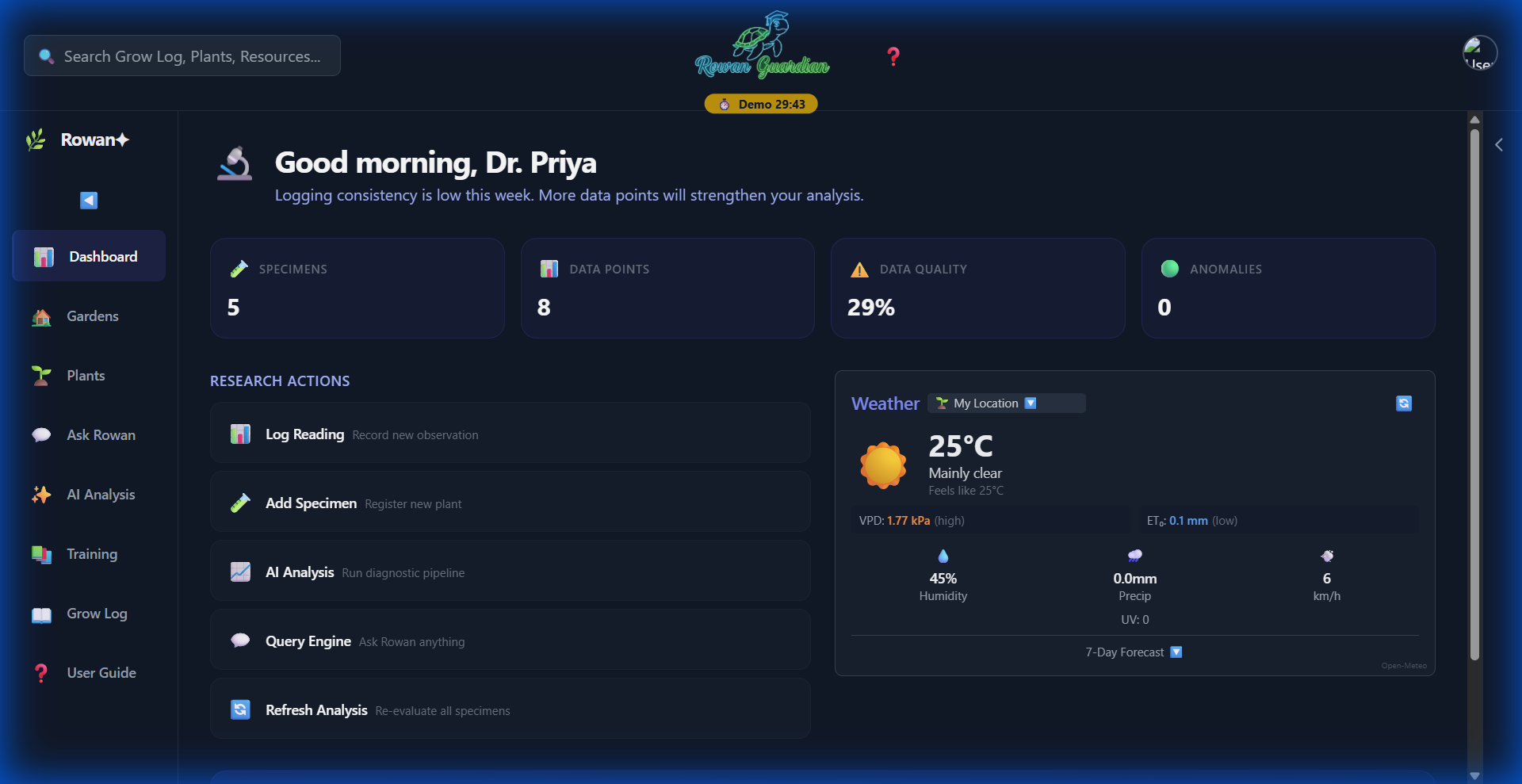
Researcher Dashboard — Dr. Priya Sharma, Pune India

Field Data Collection Is Still Painful

📋

Scattered Data Sources

Soil sensors, weather stations, growth measurements, photos, and lab notes — data lives in spreadsheets, notebooks, phone cameras, and multiple apps. Integration takes hours.

⏱️

Manual Entry Wastes Time

Reading meters, recording values, dating entries, organizing by treatment group — the data collection process itself takes time away from actual research.

🤖

AI Tools Give Shallow Answers

Most AI assistants can't handle nuanced agricultural research questions. You need statistical context, confidence intervals, and evidence-tagged reasoning — not vague suggestions.

Your Lab Notebook, Supercharged

Rowan's Researcher experience speaks in precision values, offers statistical inferences, and exports data in formats your analysis pipeline already uses.

📊

Multi-Variable Sensor Comparison

Compare EC, pH, moisture, temperature, humidity, VPD, CO₂, and PAR across treatment groups, time periods, and growing zones. Interactive charts with standard deviation bands and trend lines.

Dr. Sharma's setup: Wheat biochar field trial — HD-2967 (control) vs. PBW-343 vs. DBW-187. Daily VPD, EC, and soil moisture tracked across all three varieties.
📁

Publication-Ready Export

Export all data to CSV or JSON format — structured for direct import into R, Python pandas, or SPSS. Includes timestamps, metadata, sensor calibration notes, and treatment group labels.

One click: Download your entire dataset with proper headers, units, and ISO 8601 timestamps ready for analysis.
🔬

Experiment Snapshots

Capture point-in-time snapshots of all variables for a specific specimen or treatment group. Compare snapshots across dates. Mark anomalies for follow-up.

Precision values: EC: 1.24 ±0.03 mS/cm, pH: 6.8 ±0.1, Soil Temp: 22.4°C ±0.2 — all with full measurement metadata.
🧪

Statistical AI Reasoning

Ask Rowan to compare trends, identify deviations, or analyze correlations. Responses include means, standard deviations, percentage deltas, and confidence assessments grounded in your actual data.

Example response: "PBW-343 VPD μ=1.34 kPa (σ=0.15) — elevated Δ+19.6% vs control. Correlates with south-facing vent position. p<0.05."< /div>
📈

Time-Series Analysis

Track any variable over time with deviation flags. Rowan automatically highlights statistically significant departures from baseline and suggests potential causes.

Smart alerts: "VPD for DBW-187 dropped 2σ below 7-day moving average at 14:30. Check for irrigation overflow or sensor drift."
📖

Searchable Knowledge Base

Access peer-reviewed agricultural research through Rowan's curated knowledge base. Ask about specific pathogens, nutrient interactions, or growth models — get citations, not opinions.

Evidence-tagged: Every claim is labeled [Fact], [Inference], or [Speculation] with confidence scores and source references.

A Real Research Conversation

🌱
Ask Rowan — Researcher Mode
Compare VPD trends across my three wheat varieties this week.
VPD Analysis (Feb 8–15):

HD-2967: μ=1.12 kPa (σ=0.08) — optimal range
PBW-343: μ=1.34 kPa (σ=0.15) — elevated, Δ+19.6% vs control
DBW-187: μ=1.08 kPa (σ=0.06) — within parameters

[Inference] PBW-343 deviation correlates with position near south-facing vent. Consider repositioning or adding shade cloth.

[Recommendation] Export week's data for detailed regression analysis. JSON export includes hourly readings suitable for R.

Confidence: High · p<0.05 for PBW-343 divergence · n=168 readings per variety

Ready to Upgrade Your Field Research?

Join the waitlist and be first to experience Rowan — your 24/7 AI cultivation companion.

✅ Full data export✅ 8 sensor types✅ Statistical AI responses